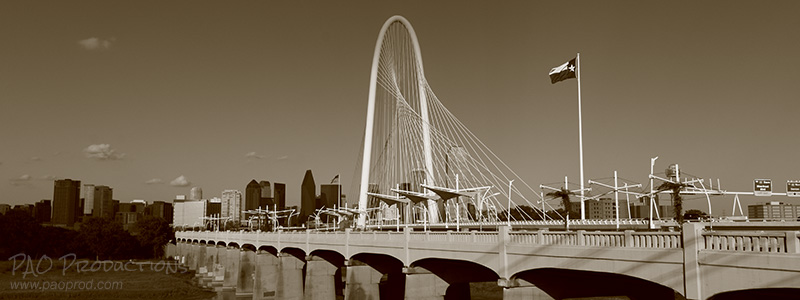

Bjorklund & Moore
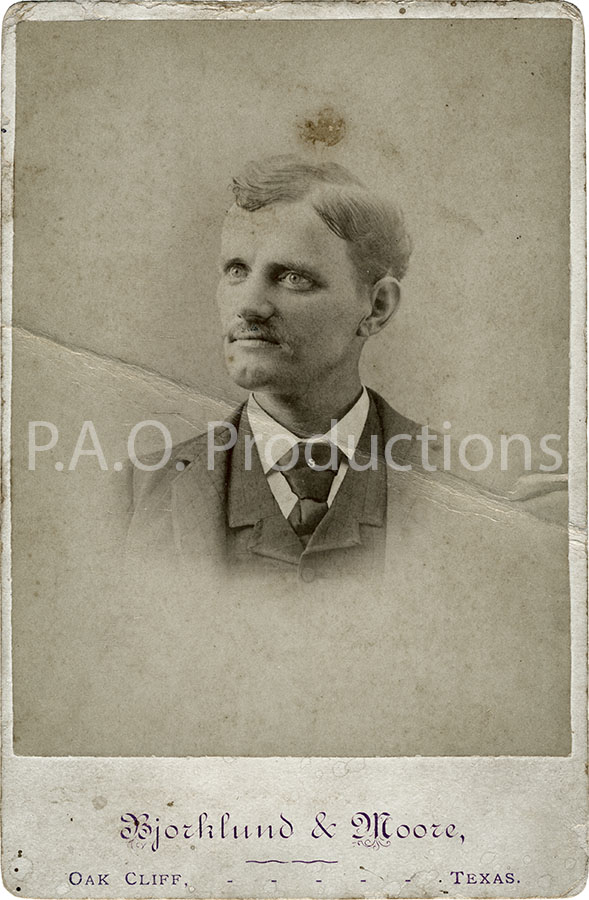
Aside from the single mention of Bjorklund & Moore studio in the city directory, no other records of the its existence appear to have survived. I have been unable to unearth any references to any variant of the studio’s name in available period newspapers or advertisements. The address as given in the city directory is inexact, making precise searches based on the building’s history impractical. And no credible information appears to have survived regarding the two proprietors outside of the rare period cabinet card. Neither Bjorklund nor Moore appear as individuals in any Dallas city directories either before or after 1891. Judging from what little information there is to work with, which is almost nothing, the enterprise appears to have been short-lived, and to have left little to no mark on local history.
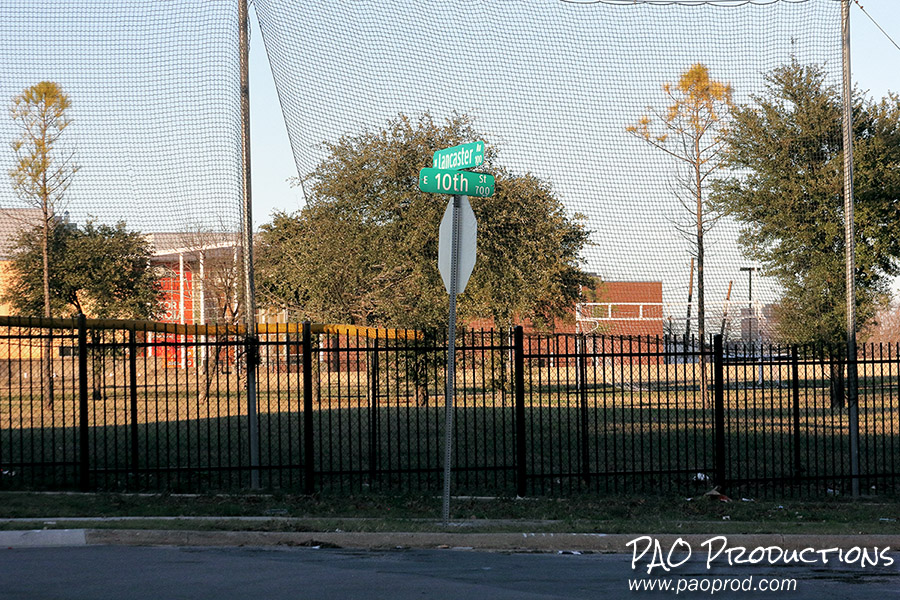
Today the southern portion of the Hector P. Garcia Middle School campus occupies the area which once held the Borklund & Moore studio.
Mitchell's studio
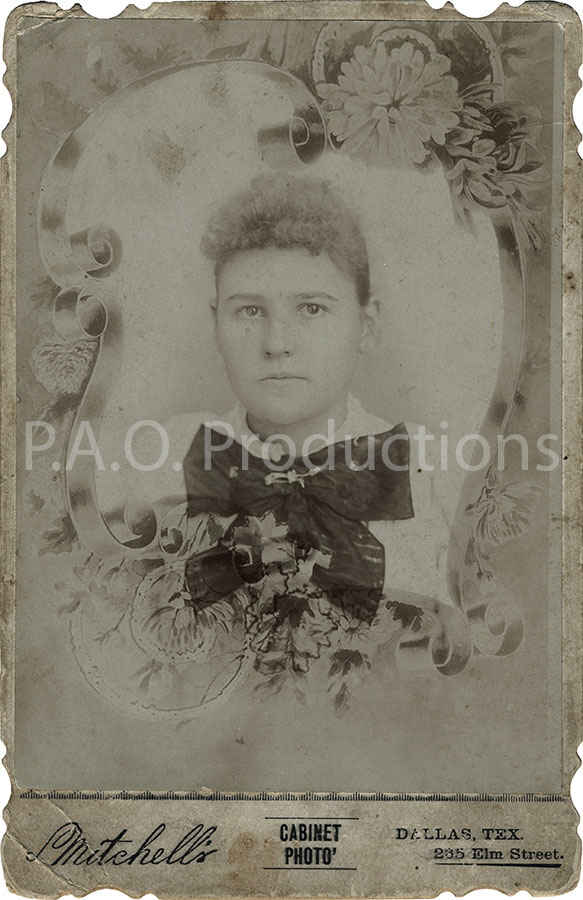
Looking at the limited information available, it's possible to piece together some idea of how the Mitchell studio might have come into being. The building began life, at least as far as available documentation is concerned, as a clothing store, a "Globe Clothing House" situated at what was then 703 Elm near the corner of College Street. Early advertisements for this address appeared in the Dallas Morning News at least as early as November 1885, and by this time, there was a photo gallery on the second floor. By 1889, the 703 Elm address was the home of one of W. Wirt Williams’s two concurrently run studios on Elm Street. A December announcement in the Dallas Morning News that year referred to Williams's 703 location as "Hillyer's old stand,” though contemporary references to H.B. Hillyer's studio and the surviving cabinet photos themselves referred instead to the adjoining 701 Elm address. Henry Jaenucke, a former photo printer for J.H. Webster and one time associate of R.L. Chalmers, was managing Hillyer's space by July 1889, and a contemporary newspaper announcement of this also referenced 701 Elm Street. Could the advertised galleries at 701 and 703 actually have been a single location, located on the upper story of 703? Period Sanborn fire insurance maps confirm the existence of a photo studio on the upper story of the 703 address while showing no such establishment for 701, the widely confirmed address for Hillyer’s establishment. Was Jaenucke in the employ of W. Wirt Williams before the latter's relocation down the street to 904 Elm? Available information provides no firm clues as to the exact details, and Henry Jaenucke disappears from the historical record after 1889. What is clear is that in 1891, the 703 Elm Street address became 265 Elm, and by 1893, 265 Elm Street was the location of a restaurant run by J.W. Mitchell.
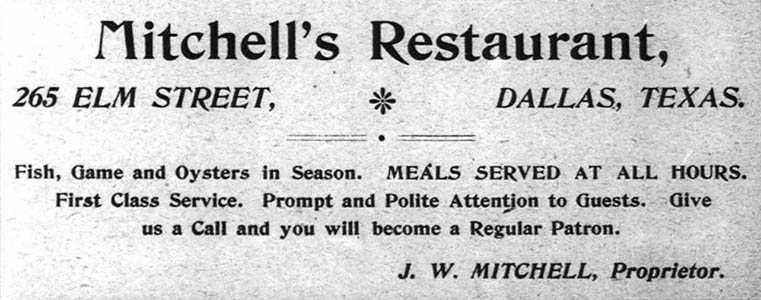
James Wesley Mitchell hailed originally from Arkansas. Exactly when he first came to Dallas is unknown; he does not appear in city directory listings prior to 1896, although Mitchell's Cafe and Restaurant opened its doors in 1893. Mitchell wed Indiana-born Emma Lang sometime in 1896, and it may have been through Emma’s brother George, who was already in the restaurant business, that Mitchell came to throw in his own lot. The restaurant seems to endured for about a decade before Mitchell pivoted to real estate, after which time the building was given over to the Dallas Free Kindergarten Association for use as their new dining hall.
Throughout the restaurant's tenure, and indeed after its subsequent repurposing as a dining hall, the building at 265 Elm served as a home for a number of individual renters. The 1902 Dallas city directory records over a dozen different people rooming at the 265 Elm Street address, many of whom were in the employ of J.W. Mitchell in occupations related to the restaurant. Even after Mitchell's departure, furnished rooms continued to be advertised via newspaper announcements. There is nothing in available records to suggest a firm connection between any of these tenants and the business of photography, and indeed nothing directly tying the Mitchell family members themselves to it. Yet there apparently was a studio, and it evidently bore the Mitchell name. Was the studio run by one of the tenants in the upstairs rooms, where W. Wirt Williams (and possibly Hillyer and Jaenucke) had received customers a decade earlier? Did such an entrepreneur trade on the name of the restaurant as part of a mutually beneficial agreement with the Mitchell family? Was the studio a hand-off, or a continuation, from Williams to a new proprietor who maintained its use for the business of photography? There is no way to be sure based on what survives in the historical record. The provenance of the “Mitchell’s” studio is thus a matter of (semi-educated) guesswork.
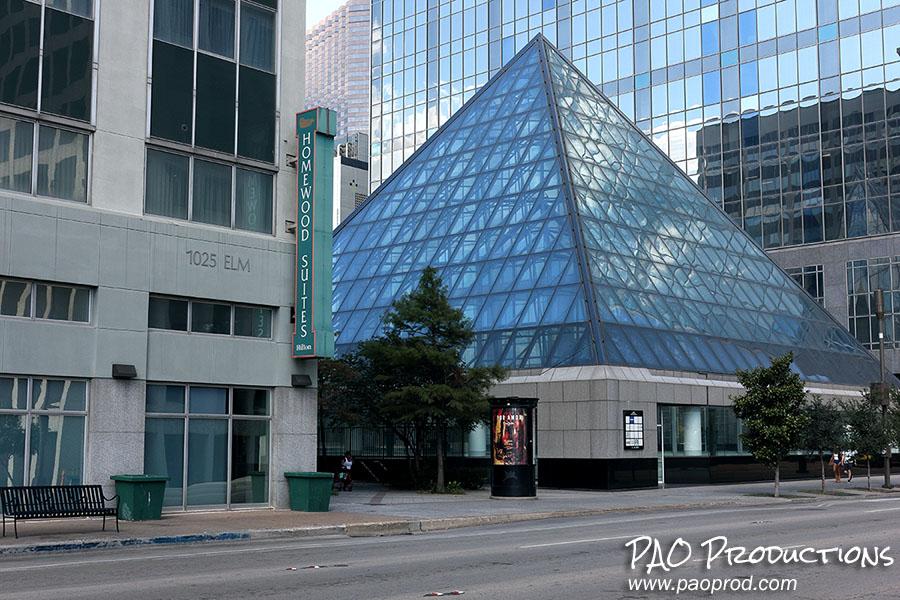
Today the one-time Mitchell restaurant and studio site is occupied by the Hilton Hotel Homewood Suites.
William Phelps
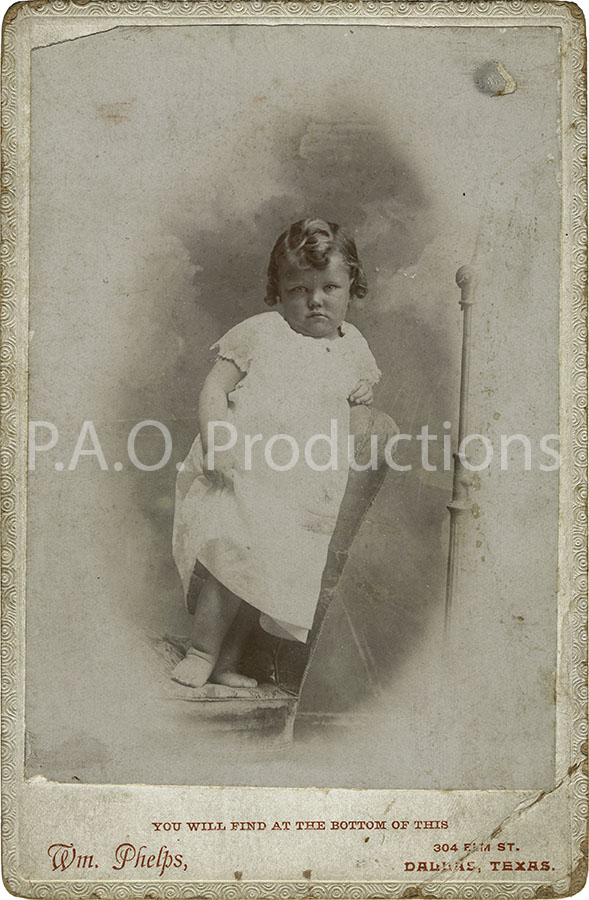
Determining exactly when the Phelps studio was in operation is a matter of conjecture. However, an educated guess can be made by way of the scant clues available. R.L. Chalmers occupied the space at 304 Elm until his departure from Dallas sometime after September 1894, and the space was in use by T.J. Bedford by the time the 1897 city directory went to publication. Phelps appears to have been a live-in manager during his time working for W. Wirt Williams, but by 1896 he was listed as residing at the Exposition Avenue address. His time as an independent operator thus seems likely to have been around this same period. Examples of his studio's output are rare, given its relatively brief life.
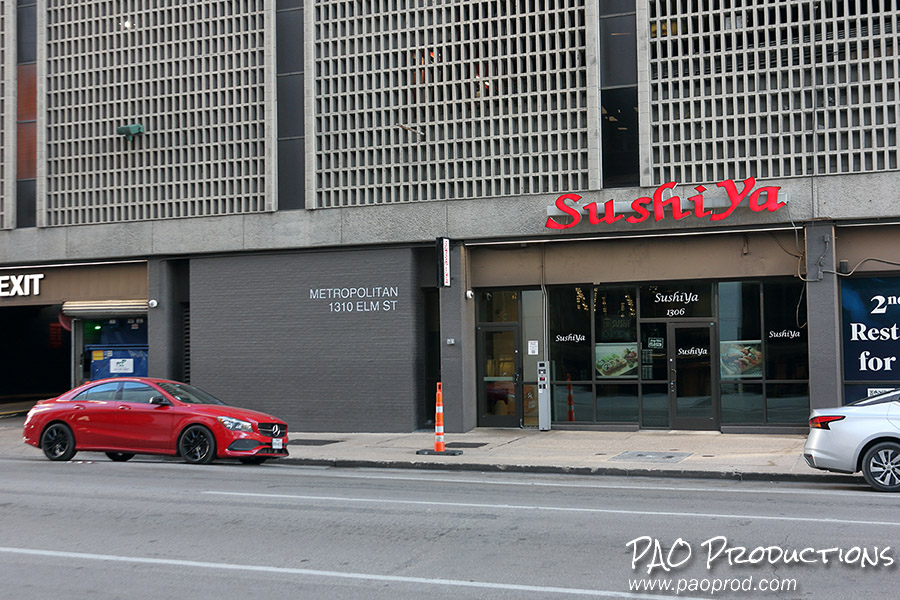
Today the 304 Elm Street space would be numbered as 1308, which falls between a parking garage and sushi restaurant.
Travis & Birkland and the La Belle studio
My 2025 piece on Emma Lucore was originally intended to be part of a more comprehensive survey of early female photographers in DFW. Ultimately, I made the decision to concentrate fully on Lucore and her story without the distraction of trying to cover others for whom much less history is certain. Unlike with Lucore, information on other female photographers operating during the nineteenth century is scant, or, more accurately, inadequate. A Mrs. E.B. Cook ran a studio at 823 Main Street in Dallas (present-day 1301 Main) in 1883, but is only listed in a single city directory volume. Miss Fannie Frost operated one at the corner of Elm and Poydras as of 1893, for which a similar lack of information exists, and I may revisit her in a future piece on Poydras Street. Lastly, Florence Potter and Allie Miller successively ran a studio at 298 Elm Street (present-day 1302 Elm) around the turn of the century. Examples of the work of any of these photographers are extremely rare, and as of this writing I've never set eyes upon anything in any form whether physical or digital.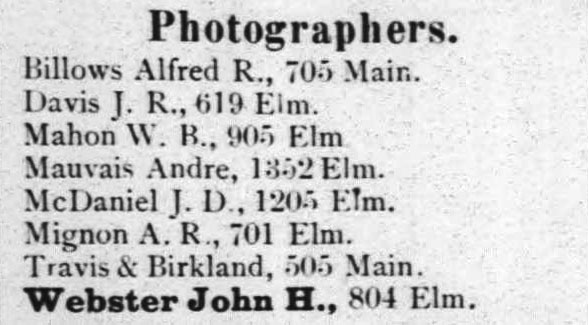
The Fannie Travis-Catherine Birkland partnership appears to date to about 1885. Exactly how the two met and what prompted them to go into business together are details that have been lost to history, and neither woman appears to have any documented presence in the city of Dallas prior to this time period. An October 1885 announcement on the Dallas Morning News "Personals" page recorded a departure of the pair to Fort Worth for what is described as a "brief visit." This is the only reference to Travis outside of the photography studio that seems to have survived in any form; no further details of this or any other travels appear to be extant. The earliest apparent mention of Birkland appeared in a June 1885 issue of the Dallas Daily Herald, which included a Mrs. Kit Birkland in a list of parties for whom unclaimed postal letters awaited pick up.

Historical information as related to Birkland is extremely sparse. My attempts to trace her through Census records, published announcements, genealogical records, and via tenuously made connections to apparent family members, have yielded barely anything definitive, though it does appear that she hailed originally from Chicago before making her way to Dallas. Despite the "Mrs." honorific, Birkland seems to have come here alone – while a later listing in the 1888 Morrison & Fourmy's General Directory of the City of Fort Worth records her as widowed, a January 1887 announcement in the Chicago Tribune reveals that her husband, Ormand D. Birkland, filed for divorce on grounds of desertion. Whether Catherine Birkland made the acquaintance of Fannie Travis after her arrival in Dallas, or whether there was some previous connection between the two, is unknown.
Travis and Birkland set up shop on the upper story of 505 Main Street, above the Fear & Jones book and stationery establishment. Which specific photographic services were offered, and what kind of deals were proffered, can only be guessed at; nothing explicitly tied to the Travis and Birkland names has ever turned up in my research. However, there is reason to believe that the studio may have been operated under a name separate from those of its two proprietors. In 1885, around the same time as the earliest local references to the two women, newspaper advertisements for a La Belle photographic studio began appearing in local publications, with the earliest one I've uncovered having gone to press on May 20, 1885 in the Dallas Daily Herald. These shine a light on the studio's specialty work with children and call out the firm's crayon work and "fine photographing." Nowhere in any of these notices are found the names Travis and Birkland, but there are clues to suggest a possible connection.
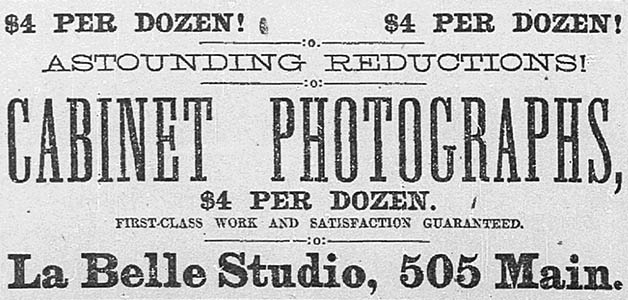
The most obvious argument for a connection of the two women to La Belle is found in the name itself: "La Belle" is arguably suggestive of female ownership, particularly given the time period. This line of reasoning is, however, hypothetical and at best very dubious. Potentially more convincing are the La Belle advertisements' references to Fear & Jones, the prior documented association of the two women with each other, and the confirmed dates associated with the studios as found in contemporary publications. The first – in fact, the only – reference to a Travis & Birkand studio in a Dallas city directory appeared in 1886, and it listed the two proprietors by name. Nowhere in the publication does any establishment with the name of "La Belle" appear. That year’s directory volume, as reported by the Dallas Morning News on May 30, 1886, had been in production for the prior four weeks, suggesting that work on it began in early May. The final published ads for the La Belle photographic studio appeared three months earlier in February. Morrison & Fourmy's General Directory of the City of Dallas, 1886-87 has a Library of Congress copyright date of August 10, 1886, providing further support for the possibility that the La Belle Studio may have also been the Travis-Birkland studio.
Unfortunately, none of this evidence is enough to assume a firm connection, because an overlap in time can't be proven for sure. The only explicit reference to Travis and Birkland as a unit before 1886 is the announcement of their trip to Fort Worth the previous year, a notice which makes no reference to photography. And it must be acknowledged that, although the 1886 city directory's completion during the titular year (rather than during the previous year, as often happened with such publications) is an established fact, there's still the possibility that the 505 Main Street studio changed hands in the period between the final La Belle advertisements and the beginning of work on the 1886 city directory, a time period of approximately nine weeks. While this brief span makes a hand-off seem improbable, it can't be ruled out as impossible.

It is here, with the single mention of the Main Street studio, that Fannie Travis’s story comes to an end. No further authenticatable records appear to exist for her, at least none that I've been able to uncover. But Birkland's story picks up again in Fort Worth, where she reappears in 1888 having entered into a partnership with Al Burk at the corner of East 1st and Rusk (present-day Commerce) Streets. The "Unique Gallery," as it was listed in that year's city directory, was situated in what appears to have been a boarding house known as Keller's cottage. This second photographic enterprise proved short-lived, unfortunately, due to Birkland's premature death from typhoid fever in August 1888. Notice of her passing was published in the Chicago Tribune on August 31st of that year.[1] As with the studio at 505 Main, I've never succeeded in locating a single example of the Unique Gallery's output.
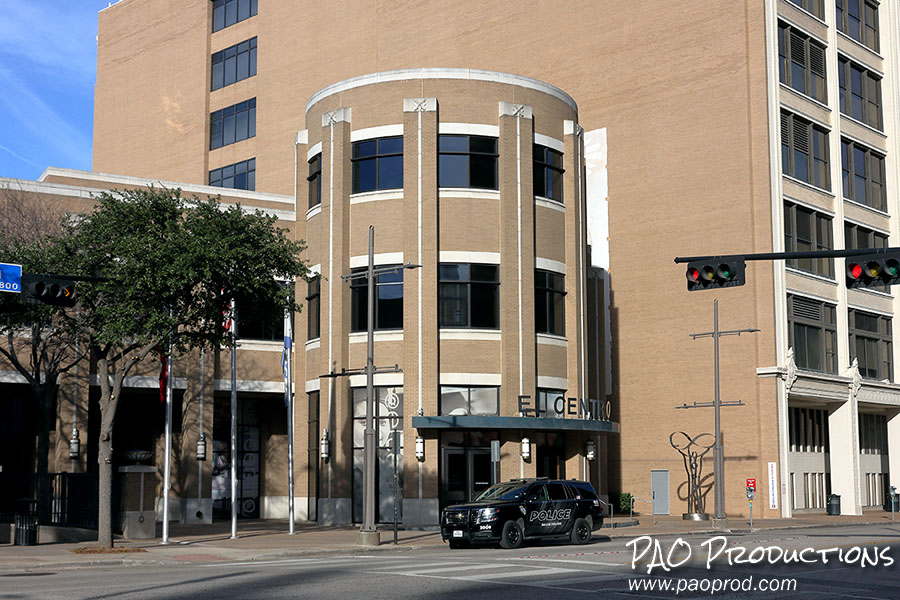
Today, the former Travis & Birkland/La Belle Studio site is part of the El Centro College campus.
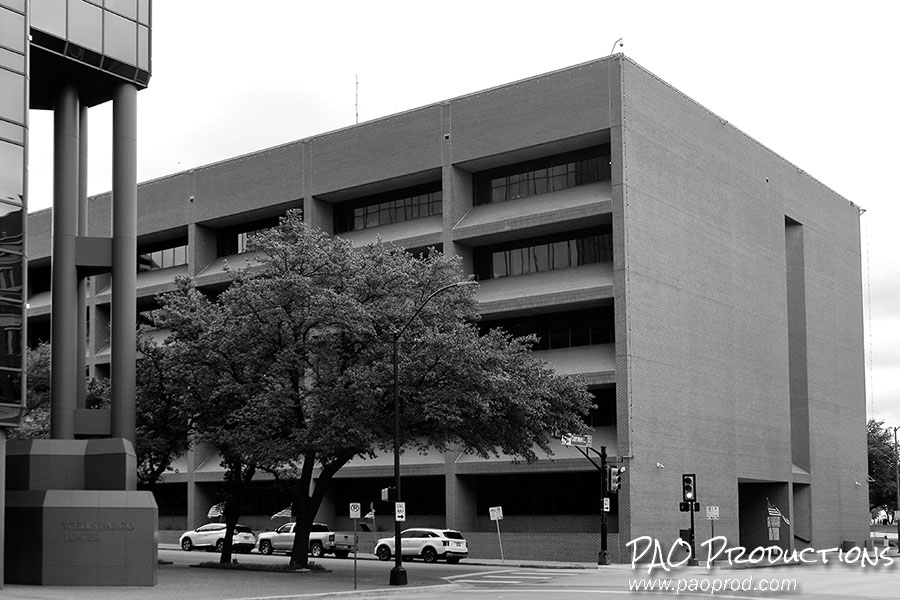
The former A.D. Burk & Co. studio site is now occupied by the Tarrant County Administration Building.
Union Gallery
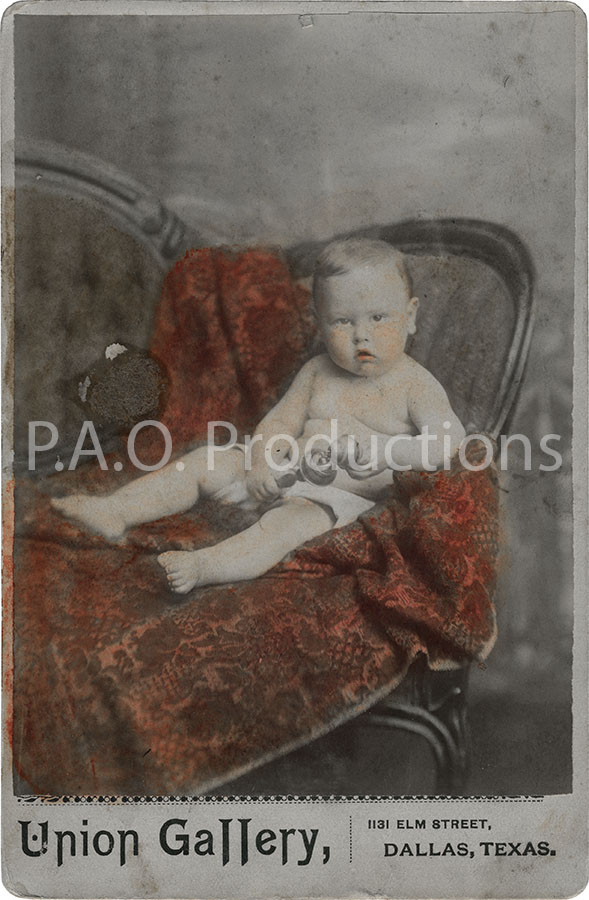
Determining what actually existed at the 1131 Elm Street address is a bit challenging. Contemporary (1880s) Dallas city directory listings show 1131 Elm to have been the location of a boarding house, and, by the end of the decade, a restaurant (and by 1891, also a bakery, though Sanborn fire insurance maps suggest the bakery to have been next door at 1133). In 1891, the 1131 Elm address changed to 505 Elm, and city directories continued to list the names of roomers at that location, indicating the building to have still been at least partially residential in nature. The bakery and/or restaurant, and the one-time presence of a skating rink on the adjacent lot per the 1888 Sanborn map, suggest that the Union studio was perhaps positioned as a firm serving walk-in customers.
Unfortunately, nothing concretely linking any particular names to the studio appears to have survived. The best clues I've been able to unearth concerning a potential owner's identity come from a smattering of city directory listings naming an Ignace Xavier Strobel at the 1131 Elm address from 1880 through 1885. Strobel was recorded as being a baker and miller, which is consistent with the bakery building situated next door at 1133 (later 507) Elm Street. An August 1885 announcement in the Dallas Daily Herald recorded the transfer of "50x100 feet on north side of Elm street, in block 124" from I.H. [sic] Strobel and wife to R.H. Chilton, but no further public listings appear to connect Strobel to the Union Gallery address after that date. Taken together, the very limited available evidence suggests Ignace Strobel as the most likely owner of the property at 1131 Elm Street during the period leading up to the Union Gallery, and thus potentially of the photo studio as well. However, there is no evidence of him ever having been engaged in any photographic pursuits, nor any clear evidence of his association with the site after 1885.

(Morrison & Fourmy's General Directory of the City of Dallas, 1880-81)
Determining exactly when the studio was in operation presents another challenge. Unfortunately, no city directory listings or newspaper items appear to have ever advertised the Union Gallery directly. It’s clear from the address on the cabinet cards I’ve seen that the time period was pre-1891, but when the studio actually opened for business is something that can’t be determined from the meager information available. Perhaps one day I will come across an Union Gallery photo with an identified subject I can trace via genealogical records to find an answer. As of now, however, the studio’s details remain shrouded in mystery.
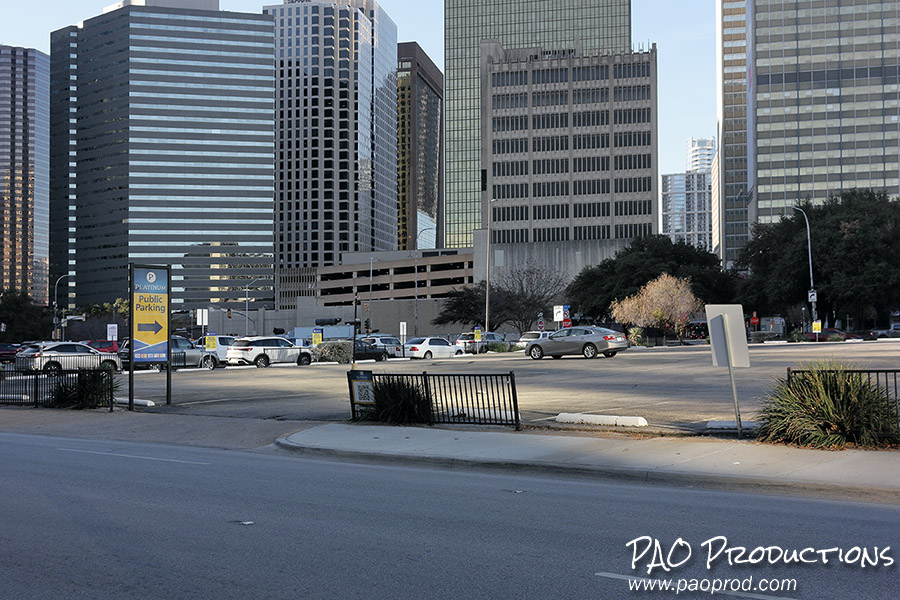
Today, the space once occupied by the Union Gallery is part of a Platinum public parking lot at the corner of Elm and Olive Streets.
The entities covered by this post do not represent the totality of Dallas' forgotten early photographers and photographic studios. There were undoubtedly other, similarly short-lived enterprises whose originators are remembered only as footnotes in local history, if at all, and piecing together their stories will present similar challenges. Any attempt to tell those stories will succeed only through a determined analysis of period advertisements, city directories, and very sparse U.S. Census and genealogical records. The full story of early photography in Dallas may in fact never be told, but anything that can be uncovered is worth preserving.
- 1. Catherine Birkland's history is difficult to trace, thanks to a lack of reliable historical references and to the confounding presence of multiple other, unrelated Birklands in genealogical records. Here I've reported only historical facts for which there is enough evidence to justify confidence in their applicability.