
bookmark_borderGhosts of DFW music history: Tombstone Factory

This is part of a continuing series of posts exploring locations of former DFW musical landmarks and the stories behind them.

Tombstone Factory show flyer, 1986
During the mid to late 1980s, the Fort Worth metal scene was on fire. While Dallas had its coffee shops, punk clubs, and new wave hot spots, a burgeoning rock music scene with its own distinctive identity was gaining currency on the west side. Of course, these two cultural movements did not exist in a vacuum, and as geography would suggest, there was indeed crossover between them which was evidenced by the existence of certain venues and a sharing of some of the principal players, fans, and musicians. But, broadly speaking, the west side of town was the more metal, a more welcoming place for headbangers and longhairs and for those interested in a more hardcore style of music. On the far westernmost edge of town there was Joe's Garage, but for those who were perhaps unenthusiastic about the long drive, there was the Tombstone Factory.

The story of the Tombstone Factory's origin has become legendary, repeated vigorously and vociferously in person, online, and via the printed page. It has been shared via anecdotes and reminiscences and secondhand accounts, circulated year after year both by word of mouth and electronically, echoed again and again in blogs and social media posts and print articles to an ever widening audience. It has found increasing legitimacy not only among those who were actually there, but among those who have since come afterward. Yet the full story of the Tombstone Factory – and its surprising antecedent – has never heretofore been told. Where the building came from, the reasons behind its construction and unique design, how it actually came to get its name, and what it actually was in its previous life – these are questions whose answers have until now been obscured by local mythology, conjecture, or even outright misinformation, for decades. The actual history is as surprising as it is unexpected, involving creatives and participants from very different communities with barely any connection between them save the one which resulted, indirectly, in the Factory's well-known name. That is the story that will be told here, and it begins in a most unlikely place.

Continue reading "Ghosts of DFW music history: Tombstone Factory"
bookmark_borderA night at the Majestic, March 1913

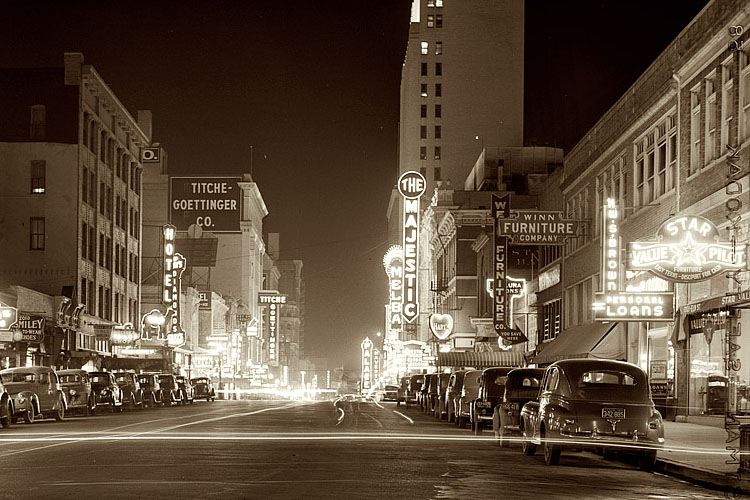
The first fifty years or so of the twentieth century were the heyday of Dallas's "Theater Row." If you're not familiar with that term, it refers to the now long gone entertainment district that once comprised approximately four blocks of Elm Street, just to the west of pre-Central Expressway Deep Ellum. For several decades, this stretch of Elm between Akard and Harwood was lined with theaters showcasing the latest in modern entertainment. Before the ascent of Hollywood, a theatergoer might find a vaudeville show or Nickelodeon-style film to his or her liking. By mid-century, it might instead be a big budget Cinerama feature showing inside one of multiple big picture palaces. The brightness of the marquees and street lamps illuminating the night sky gave Theater Row the nickname of Dallas's "Great White Way."
Looking down Dallas's Theater Row in 1942
Looking down Theater Row in 1942
Continue reading "A night at the Majestic, March 1913"

bookmark_borderEarly Dallas photography blog series

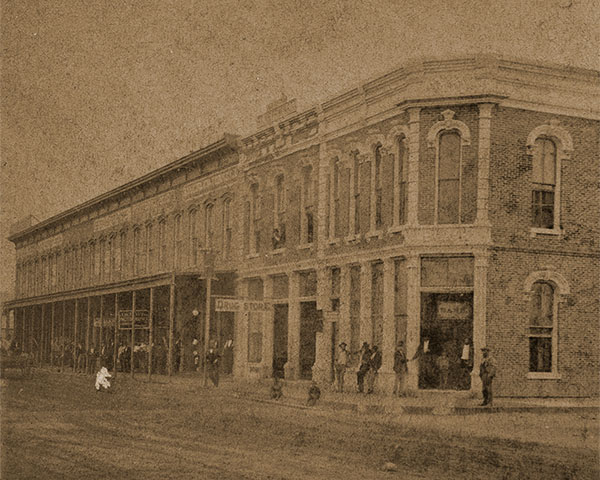
Corner of Elm Street and Hawkins in Dallas, Texas, courtesy of DeGolyer Library, Southern Methodist University
Corner of Elm Street and Hawkins in Dallas, Texas, courtesy DeGolyer Library, Southern Methodist University

Collecting vintage and antique photos is a pastime of mine, and I have an interest in local (mostly Dallas) history. Combining these two interests together into an exploration of early Dallas photography and photography studios thus came naturally to me. This series will cover the history of Dallas-based photography through the beginning of the 20th century, telling the story through both historically-minded blog posts and authentic historical images.

bookmark_borderVintage cabinet card portraits and CDVs

Here are selections from my personal collection of antique cabinet cards and cartes de visite (CDVs), many of which were assembled for my earlier Early photography studios in Dallas - a walking tour project and post. This collection of mostly local examples can be seen as a companion piece to that earlier post. All subjects pictured are unidentified unless otherwise noted. Continue reading "Vintage cabinet card portraits and CDVs"

bookmark_borderGhosts of DFW music history: Direct Hit Records

This is part of a continuing series of posts exploring locations of former DFW musical landmarks and the histories behind them.
Direct Hit Records logo

It’s 1994, and you’re in the mood for some local flavor. The DFW music scene has come into its own, and Deep Ellum is a hoppin’ place on the weekends. Local music has been taking off on the radio, and the composers and performers of said music are gaining real traction with the teen- and twentysomethings sets. Some bands are even getting signed to national labels and their music is beginning to be stocked in the big name, big box outlets. But on this particular day you’re looking for something a bit less mainstream and a bit more underground in ethos. You pile your things into the car and head out in the direction of the historic Exposition Park strip. It’s in one of those areas where people are supposedly afraid to go thanks to a reputation for being crime-ridden, but this particular carve-out is said to be safe. You pass by Forbidden Books and The Bar of Soap, negotiating the never-ending road construction, and arrive at a small retail store on Parry Avenue, sandwiched inside a row of businesses just across the street from the entrance to the fairgrounds.

Continue reading "Ghosts of DFW music history: Direct Hit Records"