

The story of the Tombstone Factory's origin has become legendary, repeated vigorously and vociferously in person, online, and via the printed page. It has been shared via anecdotes and reminiscences and secondhand accounts, circulated year after year both by word of mouth and electronically, echoed again and again in blogs and social media posts and print articles to an ever widening audience. It has found increasing legitimacy not only among those who were actually there, but among those who have since come afterward. Yet the full story of the Tombstone Factory – and its surprising antecedent – has never heretofore been told. Where the building came from, the reasons behind its construction and unique design, how it actually came to get its name, and what it actually was in its previous life – these are questions whose answers have until now been obscured by local mythology, conjecture, or even outright misinformation, for decades. The actual history is as surprising as it is unexpected, involving creatives and participants from very different communities with barely any connection between them save the one which resulted, indirectly, in the Factory's well-known name. That is the story that will be told here, and it begins in a most unlikely place.
PARIS, FRANCE, 1945. It's the waning days of the European conflict, and a young draftsman from North Texas finds himself in Europe on deployment with the U.S. Army Corps of Engineers. Coming as he has out of civilian work, his talents have not gone unnoticed, and he has been sent to the heart of recently liberated France in facilitation of the city's rebuilding efforts. Like many of his compatriots from across the ocean, the draftsman he is enamored of the myriad opportunities he has been given to encounter and experience continental art firsthand. Unlike many, he possesses a drive and artistic ambition that will allow him to absorb the key elements and attitudes of the Modernism around him and later distill its essence in such a way as to fuel his own creative fires. For while he toils preparing photo maps with the 659th Topographic Mapping Battalion, his actual passion, still to be fully realized, is for art. The number of American G.I.s stationed in Europe has been of such that the U.S. Army has run short of adequate accommodations, with the result being that many soldiers have received vouchers to enable them to procure accommodations elsewhere. The twenty-seven year old recipient of one of these vouchers is thus especially well positioned to survey the means and methods by which practitioners in one of the world's most important art centers have brought Modernism to life, and to apply his engineering and architectural skills toward the creation of his own works.
Born on March 24, 1918 in Weatherford, Texas, Charles Truett Williams hailed from a family of stonemasons. Opting not to follow his father and brother into their chosen profession, he instead enrolled in junior college and ultimately transferred to Hardin-Simmons University in Abilene. There he participated in the Art League and worked as art staff for the school yearbook, where he met his future wife Louise Beaver. Following their marriage, the couple relocated to Atlanta, where Williams found employment as a civilian draftsman for the Army Corps of Engineers, and the couple welcomed the birth of their son Karl in November of 1941. His engineering skills would come to serve him well following his discharge from the army, providing a foundation for the forays into stone and metalwork which characterized much of his later career. Following the end of the war, Williams resumed his work as a draftsman, continuing in the field for another decade.
In 1947 Williams found himself back in Texas, newly unemployed and a single parent. Louise had died of pneumonia and his civilian contract with the Corps had been terminated, and the desire to be closer to family along with the need for child care prompted the return to his home state. He set up an art studio inside his parents' Fort Worth garage and commuted back and forth to Dallas, working on water management projects for the city while pursuing personal art projects in his free time. The regional art scene at that time centered around a group known as the Fort Worth Circle, a collective of Modernist art practitioners, curators, and instructors who met regularly in "salons" coordinated by Dickson and Flora Reeder. The Circle had been the first to bring the works of modern Europe to Fort Worth, and many of its members had the benefit of formal art school training. Through association with the Circle, Williams gained valuable exposure and standing within the regional art community, participating in various exhibitions and serving as a member of an "artists' subsidiary" group formed to advise the Fort Worth Art Association.
In August of 1951, Williams married his son Karl's schoolteacher, Anita McConnell. Soon afterward, the family purchased a ten acre tract of land off an isolated patch of rural road known as Route 12, or Wrey Crest Farm Road, in the southeastern corner of Fort Worth. At that time, the area was very rural and mostly undeveloped. The L.J. Parker company would begin construction of a new housing subdivision to the immediate north, known as the Sun Valley Addition, in 1953. Construction of Lake Arlington would begin in 1956, with Interstate 820 coming a further seven years on, but in 1951 the area surrounding 5701 Wrey Crest Rd. was sparse and sleepy and thus an ideal setting for Williams's artistic endeavors. The following year, Williams supplemented the original farmhouse and barn with the construction of a thirty-six foot long structure and attached carport. The perimeter walls were composed of cinder block, with some, though not all, areas of the ceiling defined by a series of wooden slats oriented perpendicularly downward. It was in this newly built studio that Williams would bring his sculpted creations to life.
As his commissions increased, and, not insignificantly, the complexity and magnitude of the sculpted pieces themselves, the original structure's ten foot ceiling soon proved to be inadequate. In particular, a 1961 copper and bronze sheet rising a height of thirteen feet precipitated an expansion of the studio building. A thirty-nine foot long, two story addition was thus made to augment the original workshop, and to provide a means of accommodating larger art objects and commission work. The addition was styled in keeping with the original structure, with cinder block walls and a fourteen foot ceiling fashioned with the same characteristic vertical wooden slats. Most importantly, the higher ceiling allowed for the fabrication and transportation of much larger sculptures, and for the accommodation of an overhead crane to facilitate removal from the studio setting. As reported by the Fort Worth Star Telegram in December 1961: "The entire end of the studio is a huge door, which can be raised to the ceiling to allow Williams to remove large sculpture without tearing out a wall."[1] The studio would be expanded many more times over the years, and it was further enhanced by the addition of a large fireplace. This was done as a means of warming the interior, which could get very cold during winter months.
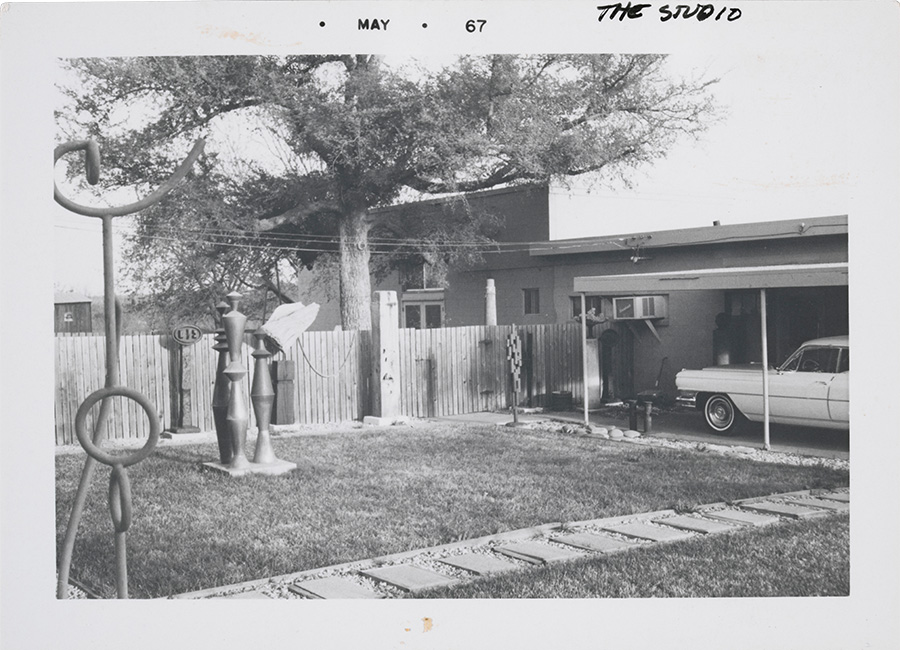
The 1961 copper and bronze piece, commissioned by and destined for the Sheraton-Houston Hotel, was emblematic of Williams's developing style and sensibilities. As his ambitions evolved, his choice of techniques and working materials likewise progressed from the ceramics and linoleum blocks with which he had begun toward the more abstract. Son Karl recalls being taken by his father to witness the damage wrought by the infamous Trinity River flood of 1949, an urban disaster which proved pivotal in his father's career – sensing an opportunity, he trudged along the water-clogged streets and flooded basins, gathering up the wood of uprooted black walnut trees as he found them in and around Forest Park. This salvage material would be incorporated into works such as his 1949 pieces Indecision and Torso, the latter of which was honored with a purchase prize at the Mid-America Annual the following year. Williams continued his work with found materials while graduating from wood to stone, and from stone to metalworking. Raw materials culled from recycling yards figured prominently in his output as he made use of various welding and lost-wax techniques to fashion his final creations.
Perhaps the most fascinating use of a material by Williams is found in the type of foundation chosen for many of his works. Karl vividly remembers his father's collection of "sepulchral artifacts," specifically the accumulation of uncarved, unchiselled tombstone "blanks" of which he made unorthodox use. Cut in half and laid on the floor of his workshop, each of these blanks would be utilized as the base of a sculpted work. Exactly where they were acquired is a subject of conjecture – to this day, Karl Williams is unaware of their origin, but he does recall that the senior Williams employed a moving company to help transport the raw materials used for his art, an outfit which notably would not move items from cemeteries. However they were transported, these pieces of stone would in time come to litter the property, particularly in the years following the artist's untimely death.
Williams's increasing recognition, and his involvement with organizations such as the artists' subsidiary, led in time to his studio becoming a place of great importance in the regional art community. "Charlie's shop" on Wrey Crest Rd., which by the early 1960s was more properly defined by its proximity to Interstate 820 and Sun Valley Drive, rose to prominence as a meeting place and respected social center. As the Fort Worth Circle declined in influence, a successor collective arose consisting of artists, art patrons, collectors, curators, exhibitors, and other notables in the community, personalities who met regularly under the auspices of Charles and Anita Williams for the purpose of art discussion and the exchange of ideas. Included among their ranks were often names such as Nasher, Weiner, Sellors, Noguchi, Defenbacher, Love, Trotter, McLean, Boynton, MacAgy and others which will be familiar to connoisseurs of mid-century Modernist art. Everyone would gather around the handcrafted bar in the one story portion of the studio, actively engaging with one another over cigarettes, martinis, and beer. "It's interesting how many notable names in the art world rested their elbows here," recalled Karl Williams, who possesses the bar, now disassembled and in storage. "The social history of the studio during its time has become so well known, and my father's role as a friend and mentor to a generation of artists so often recounted, I sometimes feel it has eclipsed his outstanding role as an individual artist."
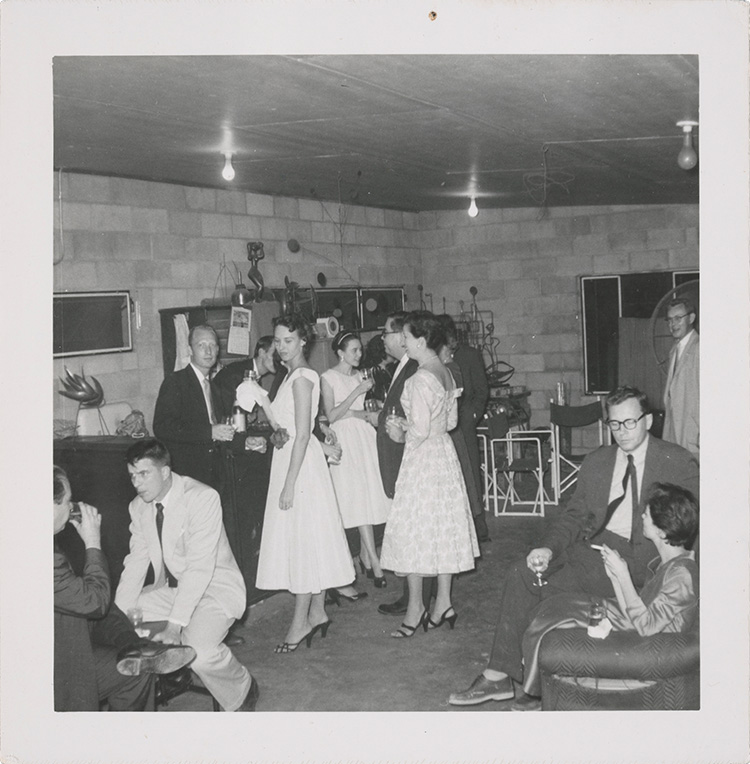
Amusements indulged in at the studio building included "The Game," an activity in which players created collaborative illustrations based on the random titles and mostly concealed lines drawn by previous participants (using paper and pencil and potentially accompanied by liberal doses of cigarettes and alcohol). Another common pursuit was the "exquisite corpse," a reimagined version of "Consequences" which saw participants building upon one another's (hidden) sketch work to create an artistic amalgamation. These two parlor games fostered group creativity and cooperation, with the completed works of art to be revealed only at the very end. This tradition of soirées at "Charlie's shop" would endure for years, having begun at the earlier garage studio but thriving to the fullest in the Sun Valley building. Visitors supported and encouraged one another, with Williams presiding not only as affable host but also as mentor. In the Fort Worth setting, the community's work found a somewhat greater acceptance as compared to Dallas, and contributors could more readily challenge the conceptions and boundaries of Modernist art while navigating the aggression that was sometimes directed at its alleged communist sensibilities.
Separate from, but consistent with, its status as a social center of gravity, the studio served the additional purpose of providing an important worksite for apprentice and student artists. Within its walls, visitors found a place where they could escape the strictures of establishments whose conservatism was unfriendly to Modernism's more sensualist side. Williams frequently opened the door to students enrolled in life-drawing classes at Texas Wesleyan College (now University), an institution where nude models were banned. The Williams studio was also the place where artists within his circle could best partake of his munificence as mentor. Jim Love, a frequent companion on Williams's salvage expeditions, learned to cast metal in the Sun Valley studio, which was generously outfitted with welding machines and metal working tools. Painter/photographer turned sculptor Ed Storms likewise learned the art of bronze casting under Williams's tutelage. Williams's art commissions and exhibition successes had enabled him to pursue sculpture full time, and he was always willing to gift his time and talents for the benefit of others while continuing to advocate for Modernist art.

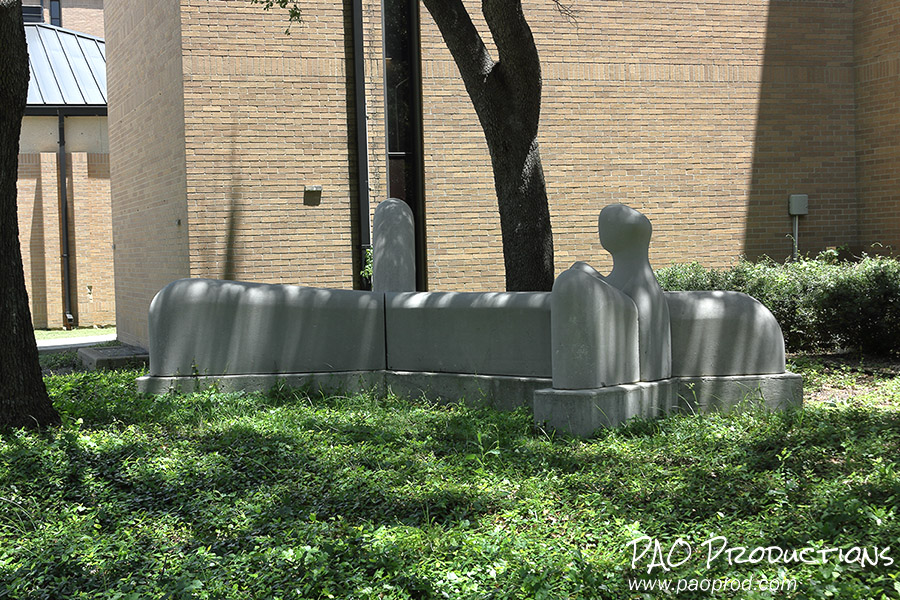
In time, interest in the Fort Worth Modernist scene and its creators started to decline, at least as evidenced by organizations such as the Fort Worth Art Center and the attention given by them to local creators. Some of the notable names from the soirées at "Charlie's shop" relocated or accepted new positions in the art world. Williams himself remained steadfast in his work and advocacy right up until he suffered his third attack in March of 1966, which proved to be fatal. His passing was followed by a collection of works contributed in memoriam by his peers in the art world, showcased by Arlington State College (now the University of Texas at Arlington). Five decades later, in 2022, the Amon Carter Museum of Modern Art featured "The Art of the Scene," a retrospective exhibition of his work which ran for a total of seven months. Surviving art pieces from the Williams studio reside now in private collections, many of them outside the Fort Worth area, and on display in facilities across the DFW metroplex. One of them, the marble crafted Earth Mother sculpture forged by Williams in 1958, currently adorns the College of Visual Arts and Design building on the University of North Texas campus.
Following her husband's death, Anita Williams continued to reside on the family's property through the end of the 1960s and well into the 1970s, before eventually selling it to a real estate group at the end of the decade. At the time of its sale in 1979, she and Karl toured the property, carrying off remaining items and materials as they could but leaving many things behind due to excessive bulk and weight. Among the items left behind were a collection of the tombstone blanks that the late Charles Williams had been so fond of utilizing, left in place because they were simply too heavy to be easily removed. By now, the rural roads that had once flanked the property had long since been superseded by a major interstate highway, and the largely open fields that once surrounded it had been eroded away by residential properties and businesses. The studio building's heyday as an epicenter of Modernist activity and socialization had passed. But if the one-time artistic watering hole now exuded its final droplets, a thunderstorm of new activity would soon be on the way to fill it back up to the brim.
FORT WORTH, TEXAS, 1986. Rock vocalist Jimi Moody is on the move. His band, Exstasy, is making its mark in the local metal scene, but as usual for a rock band in the mid 1980s, there are handicaps. Chief among these is the common insistence by most venues that bands play cover tunes, and there's always the limited number of establishments that are even receptive to his type of music crowd. But he sees an opportunity in the southeast corner of Fort Worth. His roommate and band manager, Lee Adams, has a friend who is renting an old house on a multi-acre property near Sun Valley Drive and Interstate 820. Adams has approached the friend with the idea of repurposing the unused storage building next door for a large event. The idea is to buy a keg, print up some flyers, and charge attendees by the head, with Exstasy providing live entertainment of a metal flavor. The friend has assented, and Adams has set to work with Moody and the rest of the band getting the place ready, clearing out the inside and constructing a stage. Moody will later recall the concrete walls and floors, and the debris found both inside and out: "[Adams] was a carpenter. So me, him, and other guys from the band, we... took that building and cleaned it out. There was all kinds of crap in there. While we were cleaning it out we found tombstones... just kind of laying around."

Moody and company removed the tombstones to an area behind the building, where additional specimens were found lying about the grounds. Once the interior work was completed and the flyers printed, the storage building was opened up and given its first use as a "party dump," a name for it which would surface occasionally in the years ahead. The warehouse was filthy on the inside, and there was no running water or working bathroom, but the event proved to be a success, with about a hundred people showing up as remembered by Moody. Encouraged by this, the young entrepreneurs repeated the formula the next night, once again drawing a good turnout, and before long the property became a regular hangout for throngs of music fans and party-goers. Adams's friend and his family subsequently decided to vacate the residence, leading to the "party dump" becoming a fully unauthorized, unsanctioned music venue. Remembered Moody:
So maybe in a week, maybe a couple of weeks, there was a whole bunch of people hanging out there all the time... We ended up moving in there, the band did. Lee, he didn't move in, he had a family, but we all lived there. There was no locks, no chains, nothing to lock it up with, so somebody had to stay on the premises 24/7. We rehearsed there as well. So the people move out, we move in, it's getting bigger and bigger, always somebody there all the time. We'd have a show going on every weekend.
The southeast corner of Sun Valley Dr. and Interstate 820 quickly became a hive of activity within the Fort Worth metal scene, and the storage building next to the old house soon became known as the Tombstone Factory. The proliferation of uncarved stone about the grounds, and perhaps the singular location and larger than normal lot size for the area, suggested to everyone that the property had once seen use as a tombstone manufacturing facility. "The Tombstone Factory" seemed a fitting name, and it was one that everyone enjoyed. And while the venue would occasionally be bestowed alternative monikers such as the Party Dump and the Radiation Dump, it was the Tombstone Factory name that stuck and that always remained official, the one that resonated as the most singularly appropriate. Early shows at the Tombstone naturally featured Excstacy, and a 1986 flyer reveals Psycho to have also been one of the first bands to play the venue. Cover charge averaged three dollars a head, though in time this could go up to five dollars or sometimes more in the case of a national act.

The popularity of the Factory and its events soon caught the attention of Jerry Warden, an area show promoter and radio personality who was also vocalist for a local band called Warlock. Warden had previously managed a popular metal venue in Arlington known as Rascals, and he saw great potential in a venue which was fully under metalhead control. The timing was fortuitous, as the responsibilities of managing the Tombstone and the occasional run-ins with law enforcement had begun to weigh heavily upon Moody and his compatriots. Warden's connections in the music scene would play very well for him, and, unlike Moody et al, he possessed the fortitude needed to deal with the rigors of running the venue and helping it reach its full potential. The deal was sealed. Remembered Moody:
It got to the point where it was too big for us. We knew it was special, but we also knew that Jerry could do something really good with it. And we kinda burnt ourselves out pretty quick with it 'cause there was always people there. So we came up to Jerry and asked if he wanted to take over. Of course he said yeah... He had more contacts, he was more established, he already ran Rascals, and there was a lot of harassment from the cops and everything else. It was like wow, do we really want to do this?
By late summer 1986, Warden had assumed full control of the Tombstone Factory, taking up residence in the house along with Warlock roadie Ed Falcetta. Moody and the others had earned enough revenue from the venue to pay the landlord without having to take on additional work; Warden and Falcetta also lacked regular day jobs, though Warden did have his radio show on KNON showcasing local metal. Falcetta was charged with the maintenance and upkeep of the venue ("I was actually called the Tombkeeper, because I kept the Tombstone Factory"). Warden booked the shows, primarily metal and punk oriented bands with the occasional touring or national act, and the Factory had no shortage of local talent from which to draw. Space on the inside was limited, but that proved to be of no consequence to the hordes of music fans who packed themselves into the venue night after night.
It was basically two small rooms. The first one had a low ceiling and it took up about forty percent of the building, I'd say. Then you go through this archway, I guess you would call it, and the ceiling rod rose to, it might have been twenty, twenty-five feet. And they had built a balcony that'd hold maybe fifty people, and a massive stage. It was a really tall stage... I don't know how wide, but twenty-five feet wide, I'm guessing. There was no backstage area, green room, nothing like that.
- Ed Falcetta, describing the Tombstone Factory
The wooden stage was rickety, but the bands loved it because it let them tower above the audience whereas so many other venues put them closer to floor level. In spite of this, the show-going experience could be an adventure, for both performers and patrons alike. Moody remembers the Tombstone as "a cold dump, there's no air conditioner, there's no kind of ventilation or nothing." The climate on the inside swung dramatically from stiflingly hot during the summer months to freezing cold in the winter. The number of patrons could easily swell to something far in excess of what would be considered safe capacity, creating a potentially dangerous situation. "You ain't lyin' it's the Tombstone," remembered Hammer Witch bassist Wayne Abney. "You'd be one dead motherfucker if this place caught on fire."[2] And, of course, there was the lack of a working bathroom. But none of that mattered to the crowds and the bands who regularly crowded in, eager for live music. Night after night, by hook or by crook, they came, parking in sometimes muddy fields or in nearby yards, placing their three dollar cover into the venue's tackle box, and proceeding through the club's single entrance and onward into the larger, two story room with the stage.

The scene was all ages, the atmosphere electric, the volume super loud, the situation on the floor or in the pit often insane. Underage alcohol consumption was out in the open as if it were completely legal, taking advantage of the venue's lack of legitimacy or any actual liquor license. It was, in effect, the ultimate hangout, a place where metalheads could do what they wanted without supervision or oversight from outside authority figures. "They were renting it from this old guy that lived next door to us at the Factory," Falcetta explained, "and he did not give a damn what we did as long as the rent was on time." The Tombstone allowed for a degree of unbridled, unsanctioned freedom, and over time it developed its own colorful cast of regulars, some of whom became the stuff of legend among veterans. Stories abound today of illicit drug use, of sketchy items found in yards and parking areas, of alcohol-induced "accidents" necessitating clean up action by Tombkeeper Ed Falcetta, and of cover stories concocted for parents in teenaged efforts to hide their intentions of going. And there was the all-important buy-in from people in the neighborhood, some of whom allowed patrons to park in their yards or even partook in the revelry themselves. "There was definitely a group of kids in the neighborhood who was there all the time, you know," remembered Jimi Moody. "I mean, that was the place to hang out at the time."

As for the Tombstone's lack of a bathroom, devotees came up with resourceful strategies to deal with the challenges this engendered. Some made use of the big tree out front. Others resorted to taking care of business behind the building, near the broken tombstones. Still others made excursions across the highway, sneaking into a motel on the other side and making use of the facilities there. The easiest and most straightforward solution was to use the one bathroom on the property that was actually operational, but this came with a price: "Yeah, the bathroom didn't work," recalled Falcetta with a laugh. "And fucking Jerry made people, mostly girls, pay twenty-five cents to use the bathroom in the house." The Tombstone's inadequate restroom proved to be one of its most defining characteristics, remaining a touchstone in the memories of scene veterans nearly forty years later.
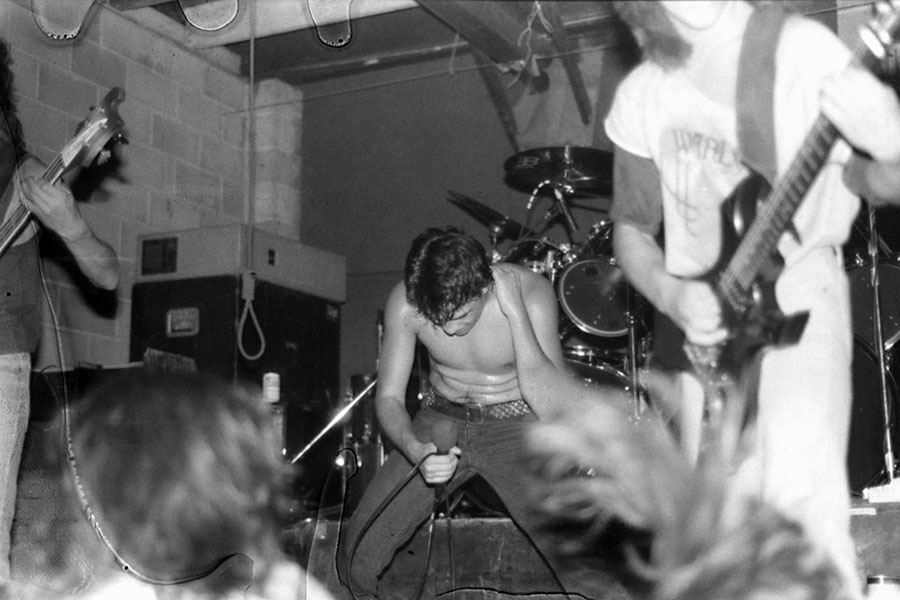
Over its short three year history, the Tombstone played host to a veritable "who's who" of local and underground talent of the metal and hardcore persuasions. Rigor Mortis, compatriots of Warden and Perry who would soon sign with Capitol Records, played some of their first shows there, celebrating their demo release at the Tombstone in October of 1986. Impaler played that same October, and Pantera famously played the Tombstone and blew the fuses (Warden, ever the capitalist, issued no refunds to the audience). Infamously, German thrash metal band Destruction, on tour in America, flatly refused to play after catching sight of the venue, opting instead to continue on to their next stop in San Antonio. Accounts vary as to whether any other acts refused to take the stage, but the list of those who did is legion: Assassin, Deadly Force, Devastation, Discharge, Hammer Witch, Ignition, Impaler, KRAZED, Millions of Dead Cops, Pantera, Raided X, Rigor Mortis, Rotting Corpse, The Stools, Talon, Toxic, Triple AXX, Utopian, Valkyrie, Warden's own band Warlock, and many, many others all performed at the Tombstone between the spring of 1986 and the summer of 1989. Some shows were more memorable than others, some were held in high regard, and some were not. And of course, there were the disputes, and the fights, and the other incidents that took place both onstage and off.
Probably the most notorious incident at the Tombstone occurred in June 1986, at a show played by Warden's own band, Warlock. Ed Falcetta described it as follows:
[The pyrotechnician] was using Campbell's soup cans, and had a wire run through the bottom of the can, and the other end of the wire was on a car battery. And, so, he started messing with masking tape, over the top, and it would produce a massive concussion. And just a great big boom instead of flames, right? Well, this night, he ran out of masking tape on the last pot, on the last can that he made. And that was my side of the stage... And so the last beat of the last song of the Warlock gig, he makes this big explosion, and it turns out when he ran out of masking tape he used duct tape on the one that was on my side. And the duct tape did not give and the can did. And it just exploded. The P.A. went out into the crowd, and the can and some P.A. went into the band and it shredded the drums. And I was just standing right there, and I caught a piece of shrapnel maybe two inches long and it went right in my gut.
Falcetta was taken to the hospital, where the emergency room crew removed the embedded projectile. He would go on to attend a Celtic Frost concert less than a week later.
Incidents such as this one did little to endear the Factory to law enforcement, and the police were known to surveil, if not outright stalk, the venue and its regulars. Remembered Gammacide guitarist Rick Perry of Warden's rock house: "It wasn't, in any sense, designed to be a live music venue. It was just a fuckin' big cinder block warehouse... I think you had to at least get a dance hall permit or something to have live music performances, but he didn't even have that." An even bigger problem in the eyes of the law was the rampant underage drinking and the underground circulation of drugs that many engaged in. The scene was B.Y.O.B., but Warden was a manager, booking agent, and musician, not an enforcer of local regulations. Raids and police monitoring were a fact of life. "They hated us," Falcetta declared. "They'd monitor us, they'd have several squads waiting for people to leave." Warden himself rarely spoke with the police, preferring instead to lock up the residence and "tell the door person the night was over" before absconding to Waffle House. With only one means of egress, the Tombstone represented a potential trap for anyone engaged in illegal activity, but on at least some occasions it appears that the police, heavily outnumbered, ended up being the ones to leave. Some Factory veterans recall officers coming to the Tombstone and attempting to disperse the crowds to no avail. But in time, law enforcement would get its way.
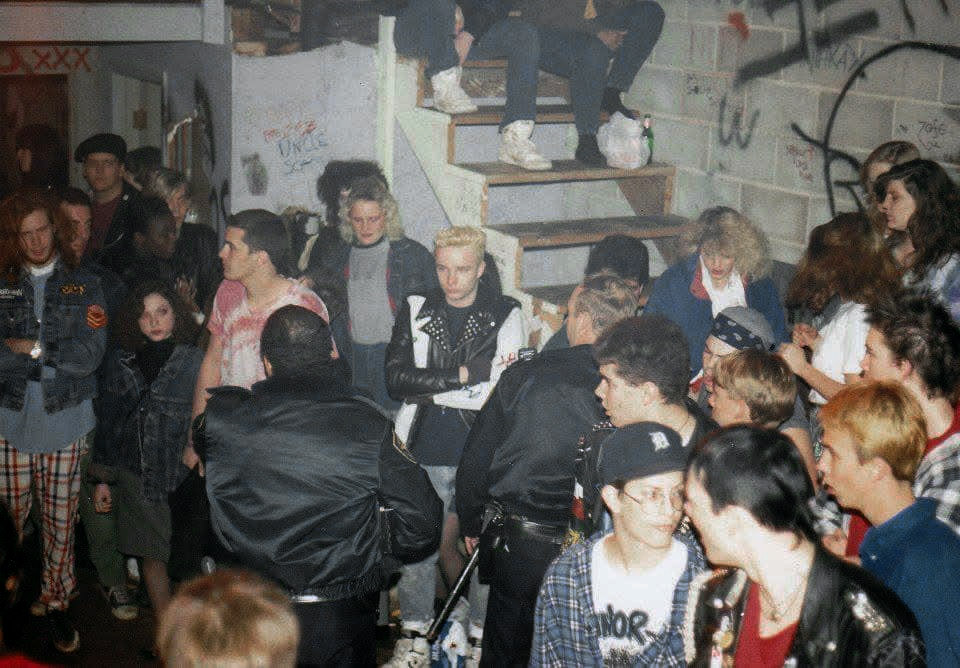
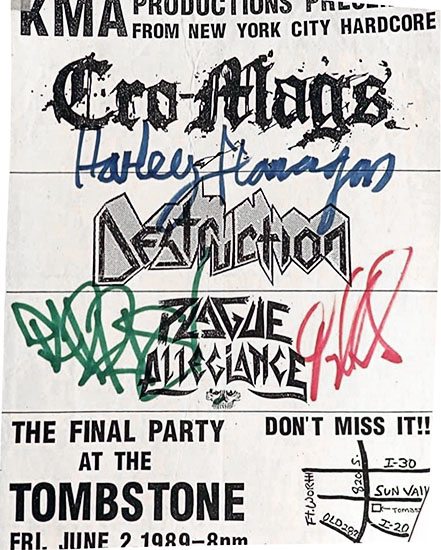
The long house party finally came to an end in June of 1989. As told by Ed Falcetta: "The cops came... and they went and talked to the landlord. And then they and the landlord came over and said 'yeah, this is over.'" The band formerly known as Exstasy, by that time rebranded as Plague Allegiance, would play the Tombstone's last show as the opening act for the Cro-Mags. The one time "Party Dump" had run its course, the three year celebration was over, and the principals would move on to other things and other adventures. As one of the original architects behind the Tombstone, Jimi Moody is proud to point out that his was the first band to ever play the venue, and the last local act to play that "final party." The lights were turned out for the last time, and the building itself, along with the adjacent house, would eventually be vacated and ultimately demolished. In 1995, a 9,000 square foot liquor store was erected on the location where the Factory had once stood.
The studio building at 5701 Wrey Crest Rd. holds a unique place in Fort Worth history, and in that of DFW as a whole. Over the course of nearly forty years and across two successive generations, it played a pivotal role in the social scene of two distinct communities, functioning as a gathering place and community hub for radically different artistic scenes and two different eras. Each community of people was brought together by a shared ethos, one celebrating not only artistic creativity and expression but also amusement, good times, and fellowship of a sort. The means of expression were different, the natures of the respective communities wildly disparate, but what they had in common was their utilization of an old cinder block building as an epicenter of their activities... that, and in a way, music. "When machines were not making noise, one could always hear music playing in the background," Karl Williams remembered of his father's studio building. "Records of Edith Piaf and Prokofiev's 'Romeo & Juliet' were among his favorites, and always on Saturday the Metropolitan Opera's Matinee Broadcast was on the radio." That the same space which once served as a home for the music of Piaf and Prokofiev during the 1950s and 1960s was unironically utilized for a much more contemporary genre during the latter half of the 1980s is remarkable, as is the fact that neither the building nor the grounds on which it stood ever betrayed any obvious indication of their former association with Modernist artists and sculptors of a generation earlier.
Minister Jimi Moody, now a wedding officiant and singer/songwriter for quirky alt-country act The Airstream Outlaws, remembers his Tombstone days as being a lot of fun, and as a credit to the venue's most well known overseer, Jerry Warden: "I give him credit for that place, the legacy of it. I give him full credit, 'cause... if it had just been us, it would've been done and forgot." "There was nothing like it in the world," reminisced Ed Falcetta of his days at the Factory. "Everybody... fucking loved that dive." About a month before the completion of this article, I had a conversation with Karl Williams, who spoke to me about his father's impact on contemporary art. Near the end, he recounted the story of the tombstone blanks and their acquisition by his father years earlier, and of how so many had been left behind on those last fateful days in 1979. He considered the fact of the intersection of 1950s and 1960s Modernist art with 1980s heavy metal, and reflected on a most unlikely association brought about by a shared fascination with the sepulchral. "I'm not surprised they called it the Tombstone Factory," he concluded.

Special thanks to the following for their assistance in researching this post and/or sharing their reminiscences and memories: Karl Williams, Alexis (Allee) Austin, Jonathan Frembling, Gaby Kienitz, Ed Falcetta, Angelo Gomez, Jimi Moody, Steve Murphy, Rick Perry, and Jerry Warden.
Excellent article, and detailed research! Well done. KL
Ikr can you even believe the pics of those martini drinkers with the pinky finger out crowd in that front room!!!
I think I was only 16-17 yrs old when I started going there! It was really gross but a lot of fun! Got sick from drinking too much in the parking dirt!🤣
The only thing more wild and dangerous that the Tombstone factory in 85-88 was a keg party at your place Shelli don’t lie! 💯😆
What a cool backstory! I was there April 26, 1986 for my 17th Birthday! Met the lead singer of Screamer and dated for years, my BFF also dated him later and they had a son. Such a cool detailed story, thank you!
I am about to read this article for the third time and I agree the research and the detailed account of the building so cool to see and know.
I was lead singer of Utopian a band you listed as played the tombstone which we did and often as anyone and for a 16 year old kid you simply there was nothing better than running around all week with a stack off flyers going to skating rinks, malls, putt-putt, gocart tracks, high schools, middle schools, drive ins, apt. Swimming pools, Cooper street, keg parties, other clubs like Savvy’s, Joe’s and Dallas to, give one to a girl it was invitation to the back seat, give one to a guy, well we never did if you wanted guys at your show say something about their mama, they wanna fight when they find that flyer in their girls purse they get drunk and head out to the tombstone to kick your ass but the place is damn frightening they end up with a bottle of Mickey’s malt liquor at the front of the stage banging their head screaming “METALLLLL!” every Friday and Saturday for the rest of the summer. I was witness to some pretty crazy action by the Ft Worth cops who took me in to custody for inciting a riot and in report I was described as a skin head, I went to a hearing 2 weeks later with long hair to my belt loops and the judge asked the detective if he could point to the skinhead he had arrested in the raid 2 weeks before and looking down at his shoes pointed at me.
I walked. Good times man, the best.
Finally found the time to read this.
I’m not much of a music head of any type to feel a certain way about this place and its history, but even so, this was a very good read. A lot of work and research was evidently put into making this, and I respect that. Always nice to learn some obscure history in DFW.