The adventures and various works of a photographer, road tripper, former patron of the local arts, aspiring app developer, and late night coffee drinker and conversationalist.
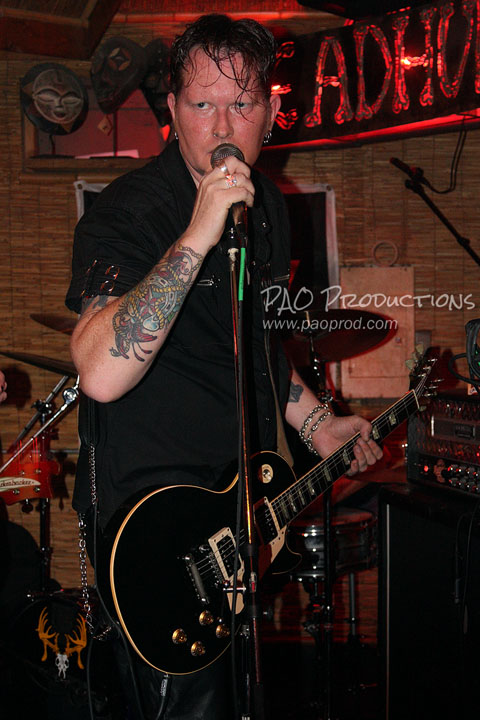
By early 2014, I'd been photographing live performances for a full seven years. Deep Ellum was "coming back," on the upswing again following a years' long period of decline. I was back where I had begun in terms of the types of venues and musical genres I was shooting, but my skill level had improved dramatically compared to the early days. The two years from 2014-2016 heralded the end of my regular activity in the scene, and a period during which I captured many of what I consider my best ever shots. The plug had been pulled on the Lost Art Open Mic in 2011, and after having largely turned my back on the spoken word scene by this time, my non-travel photography was once again singularly focused on live music. And, by and large, the live music was centered around a handful of bands with whom I had personal relationships. The bands were familiar, as were most of the venues by this time. But despite this, the act of shooting them with my camera often remained an adventure.
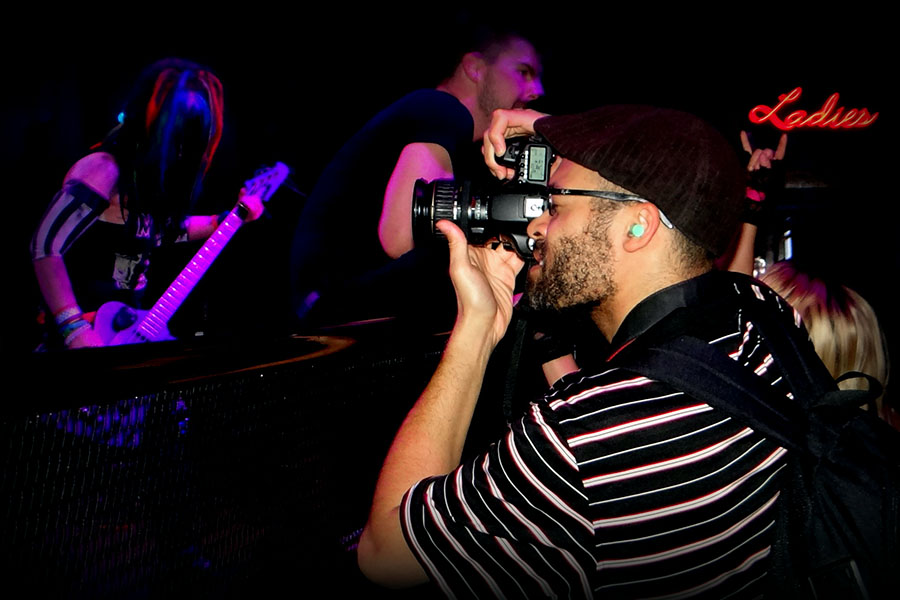
Rail Club, November 2013. Photo courtesy Metal Mina Pics.
Even though it's been a while and I've been working on multiple other ongoing projects, I am still continuing work on the Ghosts of DFW music history blog series. There are several upcoming installments that have been in development for some time, delayed in large part by my efforts to secure interviews and gather relevant historical materials and memorabilia. Much of said memorabilia is tied to venues which have not heretofore been covered in depth, and this has meant having to dig deep to get my hands on period collectibles and ephemera. And in the case of Dallas's early punk years, those collectibles have included old fanzines.
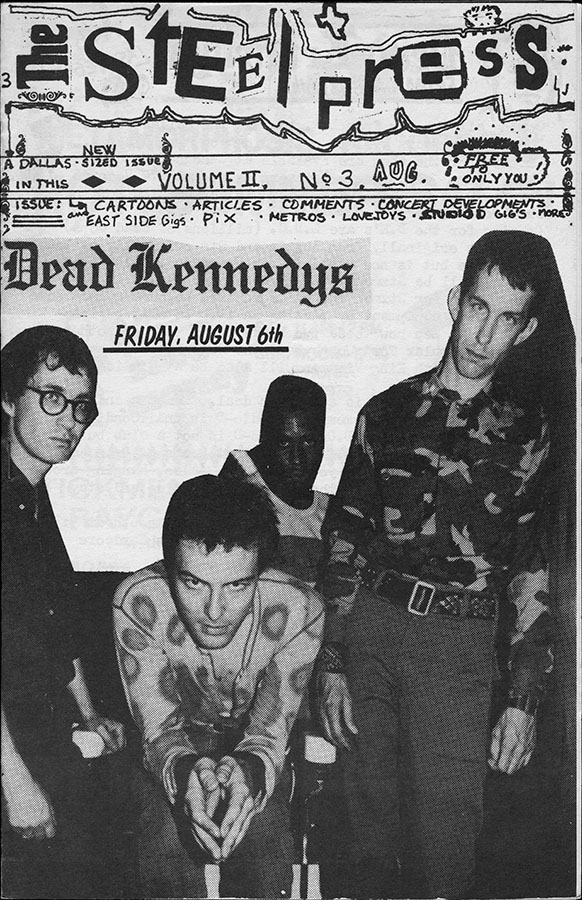
The Steel Press dates to the early 1980s. First published in April 1982, the premiere issue featured a cover story of Bad Brains playing the Hot Klub, as well as interviews with The Assassins and The Judys and various local concert listings. The two issues I've been able to obtain date to August 6th of that year and to an unspecified date after that (apparently around October 1982). Studio D, the Hot Klub, and VVV Records (all subjects of upcoming Ghosts installments) feature prominently, as do advertisements from Metamorphosis Records and listings of top-selling punk and new wave releases. The earlier issue features a cover photo of the Dead Kennedys, reproduced in a very-much-of-its-time Xerox machine style. The later issue originally appeared in two variants, the first of which included a cover story about the newly-opened Ground Zero, "Dallas's first nuclear bar." That variant is the one I have in my collection.
The Steel Press, August 6, 1982
Given the rarity of these items, and my belief that local history should be accessible to the general public rather than locked away in historical archives (even when said archives are my own), I've uploaded both of them in full to the Internet Archive here. Per a statement from the editors in the Dead Kennedys issue, "all or part of this publication may be reproduced or edited for the advancement of music and for the benefit of those who create music." Presumably (hopefully) this applies to the Ground Zero issue as well.
Rail Club, November 2013. Photo courtesy Metal Mina Pics.
I spent about nine years as a photographer documenting bands in the Dallas-Fort Worth music scene. That journey was a starting point for my interest in local music history, and having a place to showcase my photos from that experience was a prime factor in my decision to establish this website in January 2008. This series tells the story of that journey.
Not counting open mic performances, I only attended 42 shows in 2010, down dramatically from my peak of 76 in 2008. My responsibilities with the Lost Art Open Mic were a factor in this, but they weren't the whole story. Over time, I had shifted my focus to shows featuring bands and performers with whom I had forged personal relationships. This would become more and more the norm for me in the months and years ahead, with exceptions becoming increasingly rare and eventually almost nonexistent. The closure of the Skillman Street Pub in 2011 played no role in this recalibration, as I had long since ceased to regularly frequent the venue by the time of its demise. Rather, I had reached the point of burn out with the parade of cookie monster metal bands and dollar store Pantera knockoffs which seemed to make up the bulk of its nightly offerings. The way forward – for a while, at least – was in the direction of smaller, more intimate settings with increasingly limited outings to the bigger clubs.
I kicked off 2009 with a truly incendiary show at the Vampire Lounge. Two nights later, I was back for a night featuring Severed Sol. I honestly don't remember why I went to that show, as the name Severed Sol conjures up absolutely nothing in my memory, and my only notable photos from that night were a few throwaway shots of model/photographer Amber DeVille posing with a lit candle. I continued to hit up the Skillman Street Pub fairly regularly, and I began to slowly broaden my circle of venues a bit. I had a new sometimes-companion to some of the shows now, the two of us spending quite a bit of time together. That person was the Cassie B. from my 2008 birthday party and the December 20th show at Lola's. Despite certain acquaintances' insinuations to the contrary, Cassie and I were never more than just best friends – I wasn't her type, and as for me, my affections definitely lay elsewhere, with a lovely lady in the scene who shall remain unnamed. Cassie accompanied me to performances by bands such as Red Pyramid, Sidekick Mafia, and the Opus Flux, and in March we made a weekend trip down to Austin during the SXSW festival. During the Austin trip we stopped in at Headhunters and saw a performance of the Blue Flames, a band which, I was pleased to learn, hailed originally from Dallas.