The adventures and various works of a photographer, road tripper, former patron of the local arts, aspiring app developer, and late night coffee drinker and conversationalist.
New York-born photographer Arthur Rothstein made a name for himself with his many series of photos documenting America. His long career earned him recognition for his work as a photojournalist, author, and teacher, but it is perhaps his Great Depression era work, undertaken at the behest of the U.S. Farm Security Administration, for which he is best remembered today. In 1942, this assignment brought him to North Texas and to the old Fort Worth-Dallas Highway, where his photographer's eye led him to capture a string of period businesses and landmarks along the way. These images would become important historical records of their period in history, all of them eventually seeing reproduction on prints, postcards, and historical publications and websites time and time again in the decades since.
Emma Lucore's first Fort Worth studios were at 109 E 3rd Street, next door to the original Fort Worth Opera House, and at 808 Main Street, one block north of husband Bassett's wood and coal yard. Both these original studio locations are still in use today by active businesses. I paid a few visits to the area to get a look at the sites as they stand in the 21st century. On one of my visits, I was accompanied by a friend.
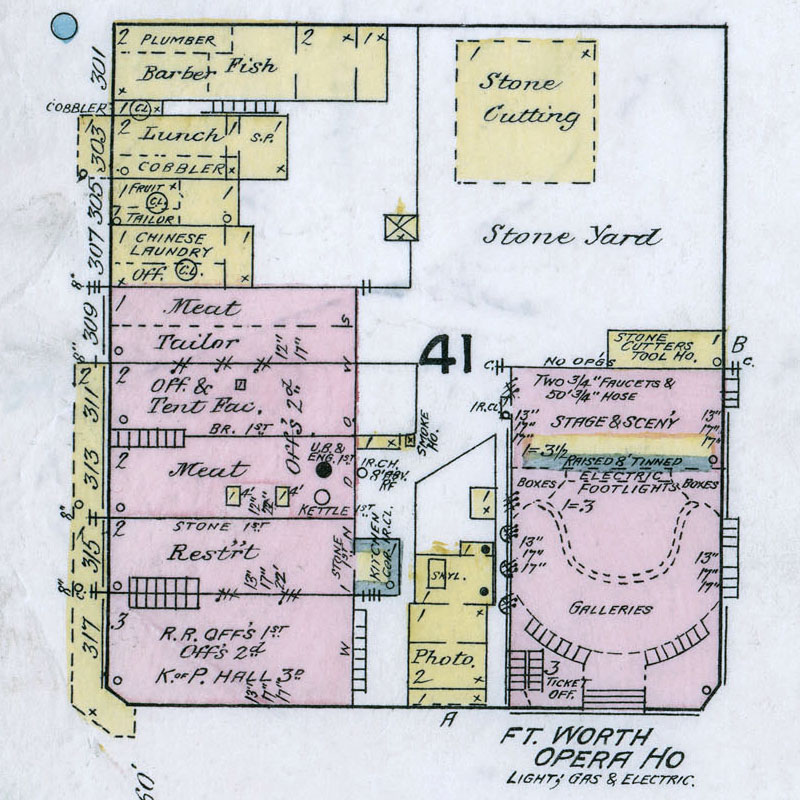
Detail of 1889 Sanborn insurance map, recording the Fort Worth Opera House and photo studio next door
Continue reading "Emma Lucore follow up: Visiting the old locations in 2025"
(Update: I visit the old Fort Worth studio locations in this follow up post)
If you're a follower of this blog and website, you know that one of my interests is photography, both contemporary and historical. I've featured several collections of vintage and antique photos alongside my own, and I'm currently in the midst of a longish-term project to chronicle the histories of early local photographers. Toward this end, about five months ago, I began assembling a collection of Fort Worth-area cabinet cards. These included works by Burdge, Daniel, Mignon, Swartz, Thomason & Leffler, Works, and one of my rare acquisitions from a female photographer, Emma Lucore. I'd never heard of Emma Lucore before then, and I decided to have a look into who she was and how long her studio was in operation.
This is part of a continuing series of posts exploring locations of former DFW musical landmarks and the stories behind them.
Tombstone Factory show flyer, 1986
During the mid to late 1980s, the Fort Worth metal scene was on fire. While Dallas had its coffee shops, punk clubs, and new wave hot spots, a burgeoning rock music scene with its own distinctive identity was gaining currency on the west side. Of course, these two cultural movements did not exist in a vacuum, and as geography would suggest, there was indeed crossover between them which was evidenced by the existence of certain venues and a sharing of some of the principal players, fans, and musicians. But, broadly speaking, the west side of town was the more metal, a more welcoming place for headbangers and longhairs and for those interested in a more hardcore style of music. On the far westernmost edge of town there was Joe's Garage, but for those who were perhaps unenthusiastic about the long drive, there was the Tombstone Factory.
The story of the Tombstone Factory's origin has become legendary, repeated vigorously and vociferously in person, online, and via the printed page. It has been shared via anecdotes and reminiscences and secondhand accounts, circulated year after year both by word of mouth and electronically, echoed again and again in blogs and social media posts and print articles to an ever widening audience. It has found increasing legitimacy not only among those who were actually there, but among those who have since come afterward. Yet the full story of the Tombstone Factory – and its surprising antecedent – has never heretofore been told. Where the building came from, the reasons behind its construction and unique design, how it actually came to get its name, and what it actually was in its previous life – these are questions whose answers have until now been obscured by local mythology, conjecture, or even outright misinformation, for decades. The actual history is as surprising as it is unexpected, involving creatives and participants from very different communities with barely any connection between them save the one which resulted, indirectly, in the Factory's well-known name. That is the story that will be told here, and it begins in a most unlikely place.