
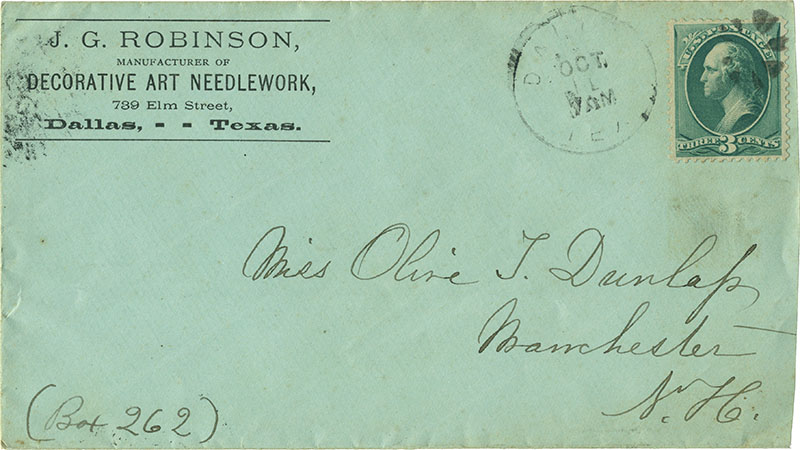
John G. Robinson's history before his needlework business is unknown. Indeed, very little information concerning his life and accomplishments survives at all in any form. Period newspaper articles and society references to him outside of his business concerns are few in number. My attempts to trace or even locate a family tree on genealogical sites came up empty. From what I can tell, his first appearances in the historical record occur in August 1882, when the earliest announcements for "J.G. Robinson, Emporium of Art Needlework" appeared in the Dallas Daily Herald. These notices promoted "stamping neatly done," as well as "lessons given in Kensington and fancy stitches." Related tools and materials were also advertised as available for purchase. Importantly for my acquisition of my antique envelope, mail order service was advertised, suggesting that the Miss Olive Dunlap whose name and address appear as the recipient was likely one of Robinson's customers.


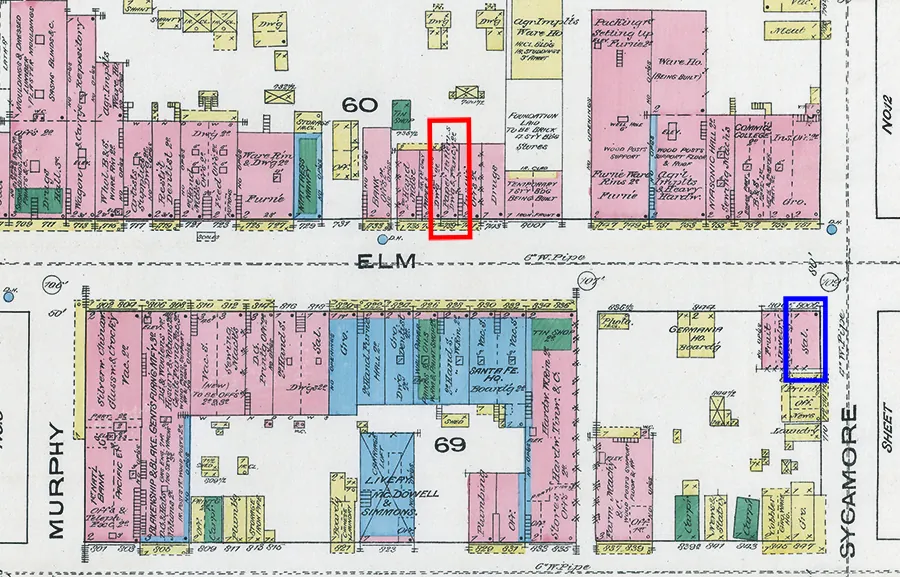
Miss Dunlap may have been inherited from the outfit's previous owner, Mrs. G.B. Carter. From about 1875 until early 1882, Mrs. Carter operated a "fancy goods" business offering near identical goods and services at the same 739 Elm Street address. In late 1881 she announced her wish to retire and put her business up for sale, and although I never found any records directly proving any transaction with J.G. Robinson, the similarities between the two businesses as far as what was sold and advertised are too strong to suggest anything other than an acquisition. By 1883, the Morrision & Fourmy's business directory listings included Robinson in connection with "stamping" at the Elm Street address. The following year's volume likewise listed his name under "Stamping and Patterns." In each of these instances, Robinson's was the only name listed in the business directory for this category. Perhaps more interestingly, the 1884-85 volume also records him as one half of a parallel enterprise with Oscar A. Roughton, with "Roughton & Robinson" being listed as the proprietors of the Parlor Saloon at the southwest corner of Elm and Sycamore.

Roughton and Robinson appear to have gone into business together around 1884 based on what's available in period publications. What brought the two men together is anyone's guess, as are the means by which Robinson came to have interests both in needlework and in barkeeping. A deeper dive into the historical record suggests that at least one of the Parlor's two proprietors (Roughton) had some prior saloon experience and that he may have purchased or otherwise acquired the saloon before relocating it from 107 Lamar Street to the Elm and Sycamore location. The 1883-84 Morrison & Fourmy's business directory reported the Parlor saloon on Lamar as being under the operation of Joseph Boylosh, and listed Oscar Roughton as a bartender for G.D. Wood at 404 Main Street. By 1884, Parlor was listed as being under the ownership of Roughton & Robinson at the corner of Elm and Sycamore[1], and an October 1884 announcement in the Dallas Daily Herald announced the grand opening of this new location by "Messrs. O.A. Roughton & Co." However, at least one prior announcement in the Dallas Daily Herald (published on June 8, 1884) referenced Roughton as the owner of the saloon before the opening of the Sycamore location, with no references made to any co-investors or co-owners. It's possible that Robinson joined with him sometime around the middle of the year, perhaps because the new Parlor was within easy walking distance of the needlework business. Of course, this is conjecture as we can't say this for certain.
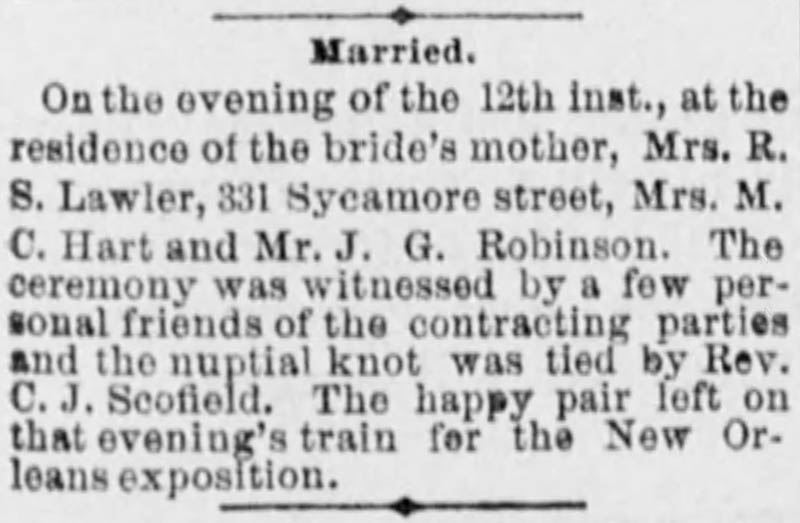
By 1885 the Roughton-Robinson business partnership was apparently dissolved. Roughton appears to have been a thoroughly disreputable character, being fined in October 1884 for "abusive language" and arraigned on charges of assault with intent to murder in September 1885. The old 107 Lamar location was by then home to the "Annex," a saloon under the operation of R.F. Meek, and references to the Parlor had disappeared from city directory and newspaper notices. On March 12, 1885, J.G. Robinson married Mrs. Mary C. Hart, a mail clerk at Sanger Brothers who had divorced her previous husband on grounds of desertion; following the wedding announcement, Robinson's time in Dallas appears to have come to an end. He was not included in that year's Dallas city directory or in any subsequent editions, nor was his name to be found in any succeeding newspaper announcements or advertisements – in fact, no advertisements for his needlework business had appeared in the Daily Herald since March 1883 (as far as I can tell), and none had ever been run in the Dallas Morning News. The wedding announcement stated that Mr. and Mrs. Robinson departed the city by train, New Orleans bound, and and an announcement published in the New Orleans States on the 15th of March confirms their arrival as guests of D.G. Hoffman. The Robinsons went on to build a new life in the city, with J.G. going to work as a painter and Mary as a dressmaker.
With J.G. Robinson's story having been told, it's time to take a closer look at the 739 Elm Street address. In the 1880s, 739 Elm appears to have seen the type of mixed-use typical for its day. The 1885 Sanborn Fire Insurance map, the earliest one available to us, describes the structure on site as a dwelling with a "paper patterns & fancy" hosted in the upper story. This is consistent not only with Robinson's use of the space, but also with Mrs. G.B. Carter's and with that of Robinson's near-successor Alice M. Napier. In 1886, Mrs. Napier comprised one third of Nesmith & Co., a association of three women which also included Miss O.V. Nesmith and Mrs. Francis S. Miller. This partnership, which operated out of 731 Elm, was dissolved in November 1887, and by the following year Mrs. Napier had moved four units down to 739, taking over from a hair goods supplier. Like the two fancy goods suppliers who preceded her, she offered stamping patterns and embroidery materials as well as free lessons. She appears to have stayed at 739 for a little under two years before moving down the street to 810.
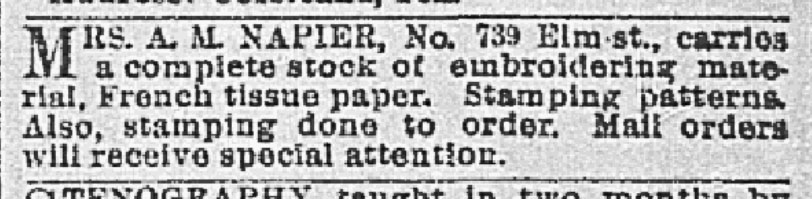
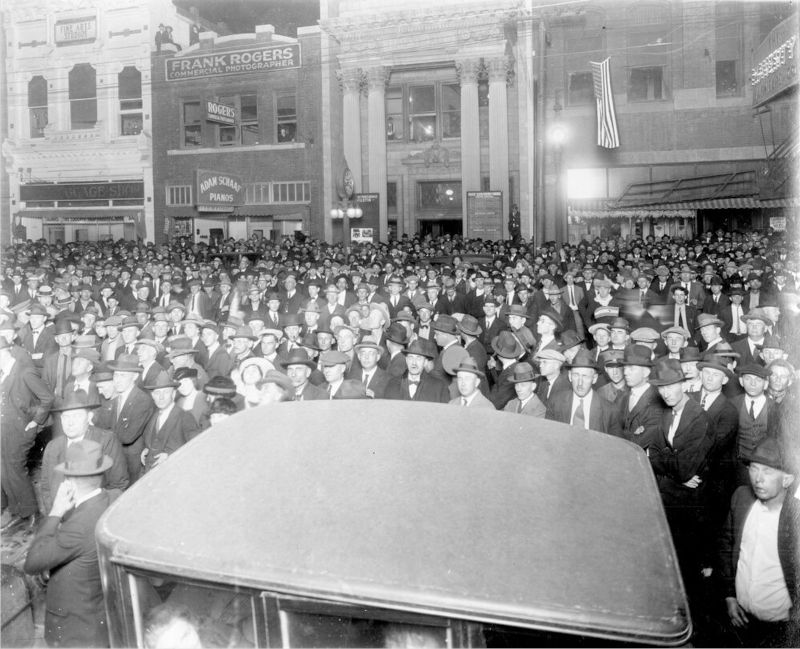
(From the collections of the Dallas History & Archives Division, Dallas Public Library)
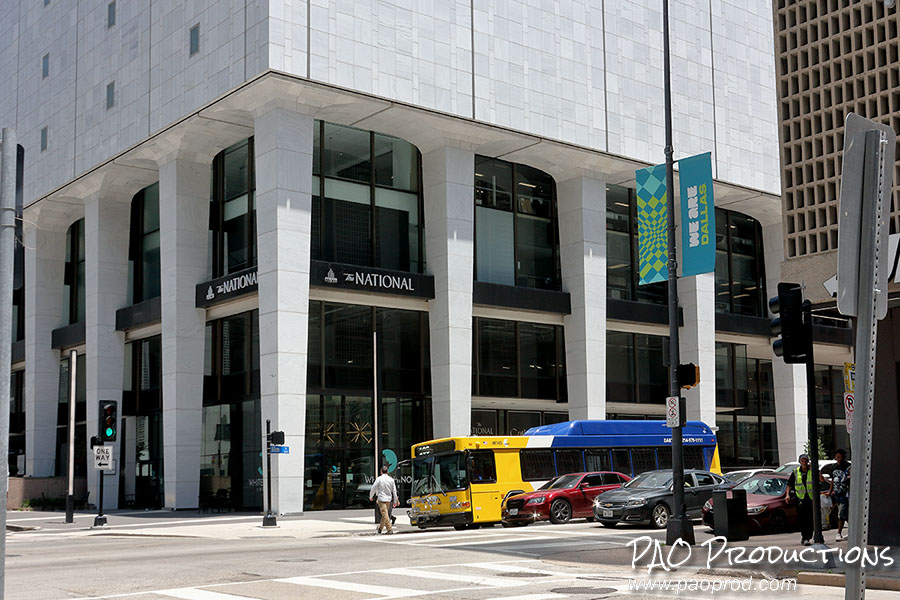
The story of early Dallas is told not only through the achievements of the Cockrells, Cullums, and other prominent figures, but also through those small, long forgotten entrepreneurs who made their brief, humble contributions to local history before moving on or disappearing completely. This post covered one footnote in that larger story, one who through his "fancy goods" and embroidery items was himself one thread in the overall tapestry of nineteenth century Dallas.
- 1. The 1884-85 Morrison & Fourmy edition contains a significant discrepancy concerning the Parlor saloon. While the main directory listings record Roughton & Robinson as being at Elm and Sycamore, the business listings at the end of the same volume record the saloon as being on the northeast corner of Lamar and Sycamore (present-day Akard). As Lamar and Sycamore both ran north-south and never crossed paths, and there is plenty of documentation referencing the Parlor's former address as 107 Lamar Street, this is clearly an error.